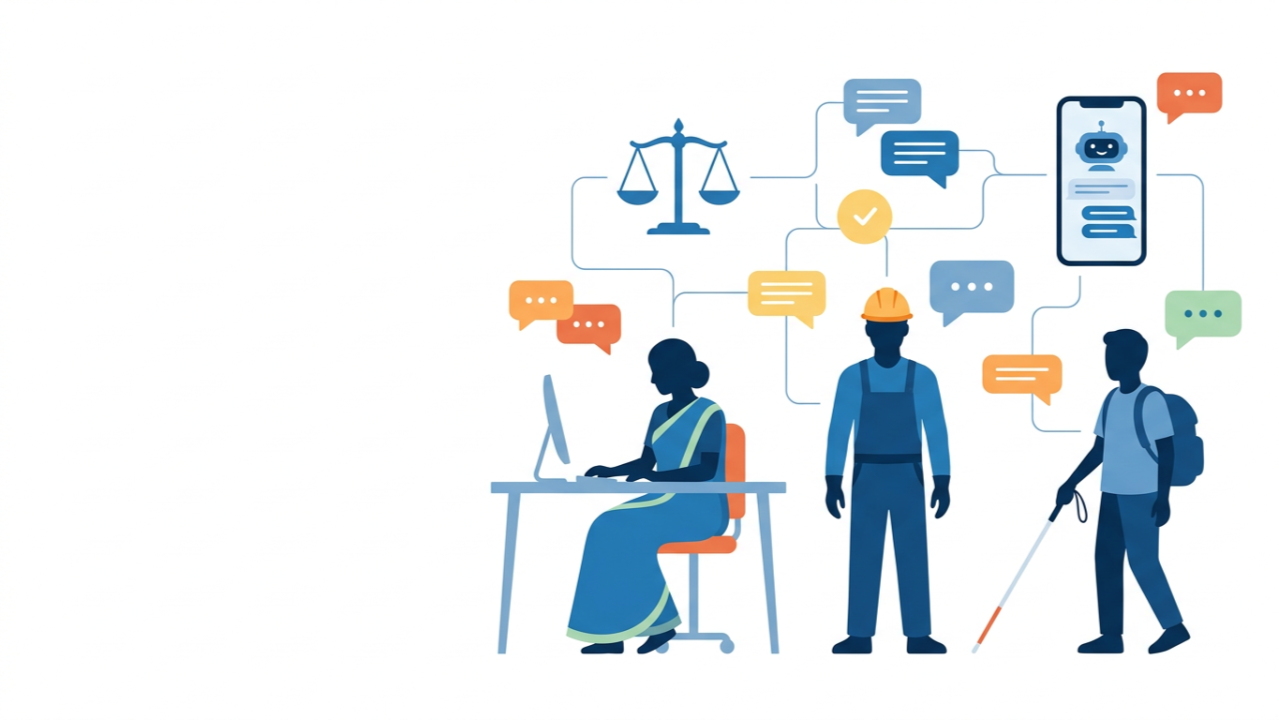
Meenakshi works at a small marketing agency where she faces sexual harassment by her senior colleague. There are around 10-12 employees in the company, which means there is no Internal Complaints Committee (ICC) as required under POSH law (Sexual Harassment of Women at Workplace (Prevention, Prohibition and Redressal) Act, 2013), and no awareness of the law among employees. Meenakshi wishes to take some action against her senior but fears losing her job if she complains. She is also unaware of who to complain to. She types out her situation on her Google browser but does not find any reliable or actionable information that can help her out. Meenakshi continues working under immense emotional and psychological pressure, knowing she does not have sufficient funds to consult a lawyer and cannot confide in anyone fearing damage to her reputation.
Priya is a contract-based worker in a cement factory in Gujarat. Unfortunately, as a migrant, she speaks and understands primarily Telugu. She tells her manager that she is pregnant. The following month she receives lower pay and is told that she has been demoted. As a contractual worker, Priya does not know if she has any rights to challenge this arbitrary demotion or if she is entitled to any maternity benefits. She searches the internet for a solution, but it gives her very vague results in English. She checks for an audio translation in Telugu, but the translation leaves her more confused than before. She continues with the lower pay and lower role, for fear of being taken advantage of even if she finds and consults a local lawyer.
Deepak, a visually impaired college student, is told by a private university that extra time and a scribe for exams is “against the rules” and that they can’t shift his allocated classroom for accessibility needs. Because of this, Deepak does not sit for his exams. He wants to take immediate action against the university but doesn’t know where to begin. He wants to talk to a lawyer but worries about the time and costs involved. He just wants to know what he can do.
Lack of knowledge of their rights and when those rights are violated, leaves people open to exploitation and exclusion. For Meenakshi, Priya and Deepak, the seemingly obvious battle is not knowing their rights, who to go to for help and where to go to uphold such rights. In all these stories, the first barrier is not the court or the police station—it is the lack of clear, contextual information about rights and the next steps. Vulnerable groups like informal workers, rural communities, women, and disabled people often lack basic legal awareness and access to affordable legal support.
Nearly 80% of India’s population is eligible for free legal aid, yet fewer than 2 million people accessed it in 2023–24, revealing a major gap between need and awareness. While several legal literacy programmes have been implemented through state- and civil society-led efforts, these have largely been one-off workshops or irregular information dissemination that rarely translates into a practical understanding of the law.
Monopoly on legal information has turned it from a basic right to a privilege.
Legal information should be available to everyone, in their moment of need, in the format they’re most comfortable with. However, lawyers have become the first point of contact for most to ask about their rights. We believe that prior access to basic legal information can improve situations before they move into legal action. Rights explained in a jargon free, accessible manner can offer alternative methods of resolution, and provide confidence to someone in understanding the recourses that lawyers are offering to them. In the above examples, if Meenakshi, Priya and Deepak had easier access to legal information of their rights in a language and format they were comfortable with, they may have defended themselves against exploitation and exclusion. Legal knowledge could have offered them a layer of protection.
We believe the first shift must be in access to legal information itself. Access to open, credible legal information that is cost-effective, jargon-free, and rooted in real-life context.
Legal empowerment begins when a person understands that they have certain rights and they are worth protecting. Therefore, legal literacy is the need of the hour. With technical advancements in the fields of natural language processing, machine learning, and artificial intelligence, there is a ripe opportunity to scale such initiatives and bring it to the fingertips of those who need it most.
But such efforts need quality expertise, appropriate tools, and trusted delivery models. Our approach is focused on creating not just accessible digital solutions but also building a community and network around it to ensure meaningful uptake and impact.
In the posts that follow, we will explore how that can be made possible, and what it takes to build tools that people can trust and use. Because Meenakshi, Priya, and Deepak don’t need the entire legal system to change overnight. They need a reliable solution at the right moment to aid them in that direction.
-Brinda G. Lashkari (Project Lead)