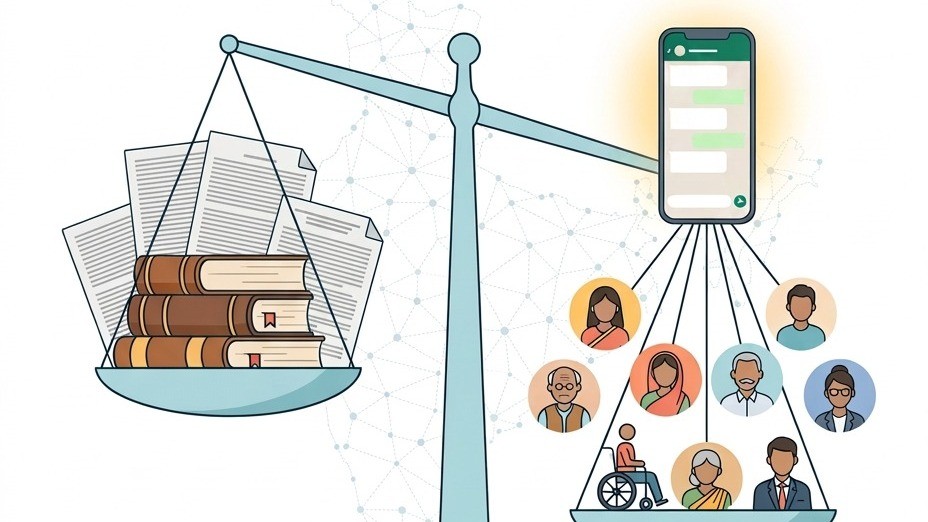
This is the second post in a series on closing justice gaps through legal information. The first explored how the absence of basic legal knowledge leaves people like Meenakshi, Priya, and Deepak exposed to exploitation and exclusion. This one asks: why is legal information still so hard to access, and what would it look like if it were designed differently?
Indian law is progressive in many respects. There are established rights with robust enforcement mechanisms. For example, the Maternity Benefit Act, 1961 (as amended in 2017) extends benefits to women in contractual and unorganised employment. The Rights of Persons with Disabilities Act, 2016 mandates reasonable accommodation in educational institutions and imposes specific obligations on universities, such as provision of scribes and accessible infrastructure. The Sexual Harassment of Women at Workplace (Prevention, Prohibition and Redressal) Act, 2013 creates a complaints mechanism to give working women an effective and efficient avenue for grievance redressal.
However, navigating and exercising these rights is an uphill challenge. The provisions exist in dense statutory language, and implementation guidelines are buried in subordinate legislation that even many lawyers don’t read closely. Further, relevant information is scattered across different ministry websites and portals.
There is a general presumption that everyone must know the law of the land regardless of their education and background. In reality though, most legal documents – statutes, rules, judgments, orders, notices, contracts, terms and conditions – are written by lawyers, for lawyers. We believe that this gap, between a right existing on paper and a person knowing that they exist and how they can exercise it, is not a legal failure; it is a design failure. The legal system has not been designed to speak to a layperson.
Legal design is not only about simplifying the law. It is about rethinking how people encounter and exercise legal rights, and to place them at the centre of legal systems. What this means in practice is to critically examine whether the law is communicated in a way that the people it is meant to serve can access it – starting from the choice of language, assumption of the readers literacy levels and medium of dissemination.
As we saw in our previous post, for Meenakshi, Priya and Deepak, the primary battle was being unaware of their rights. Of course, the employer or institution’s obligation to comply with the law does not disappear because the victim is uninformed. But in practice, the right goes unenforced. We believe that having knowledge of your rights and recourses is not just informative, rather it is the lever that can convert rights from existing in theory to being practicable. This would shift the power dynamic and allow people to exercise available choices to act on their rights.
Therefore, what is required is something fundamental, i.e. a shift in how legal information is designed, drafted and delivered. This is the problem that Setu is working on.
Designed around real-world contexts that NGO partners bring from the communities they serve, Setu builds domain-specific legal information tools. The knowledge base is curated and validated by legal experts who understand the statutes and the enforcement mechanisms, which help towards providing information that is context aware and practical.
Draftedwith the user in mind, Setu’s tools translate statutory language into plain, accessible information so that a person without legal training can understand and act on it. A combination of technology and AI capabilities allow Setu’s tool to be multilingual and audio-capable, and to disseminate information in a simple and comprehensible manner.
Delivered where people already are, Setu has chosen WhatsApp as its medium of delivery because it is the one platform that persons like Priya are more likely to already have on their phone. In 2024, WhatsApp had over 800 million users in India. The tool is privately accessible any time of day, offering both privacy and a ready recourse.
None of this replaces a lawyer or a social worker. What it does is close the gap between a person knowing nothing and a person knowing enough to take the first step.
The technology to do this at scale already exists. Large language models, multilingual natural language processing and voice interfaces are no longer experimental. What is missing is the combination of legal rigour, community trust, and appropriate delivery infrastructure to make them work in real-world contexts where access to justice actually breaks down.
Legal empowerment doesn’t begin in a courtroom. It begins the moment a person understands that they have rights worth protecting. Building that understanding reliably, at scale, in the right language is a design problem as much as a legal one.
In the posts that follow, we will explore how that can be made possible, and what it takes to build tools that people can actually trust and use.